
The nutritional reformulation strategy we follow prioritises foods that:
are predominantly consumed by children;
contain high levels of salt, sugar, fat, saturated fat and/or additives considered unnecessary;
are widely consumed and, as such, whose reformulation may have a materially positive impact on public health;
may be generally perceived by consumers as healthy, yet have a nutritional profile that requires adjustment;
contain low levels of fibre, vitamins and minerals;
contain ingredients that may cause allergies.
In 2025, we revised the recipes of 62 food Private Brand products. These reformulations prevented the consumption of 320 tonnes of sugar, 275 tonnes of fats and 39 tonnes of salt.
|
|
Biedronka |
|
Pingo Doce |
|
Recheio |
|
Ara |
|
Total |
||||||
|---|---|---|---|---|---|---|---|---|---|---|---|---|---|---|---|---|
Number of reformulated products1 |
|
15 |
|
13 |
|
7 |
|
27 |
|
62 |
||||||
Salt (references) |
|
10 |
|
4 |
|
3 |
|
15 |
|
32 |
||||||
Sugar (references) |
|
8 |
|
8 |
|
3 |
|
9 |
|
28 |
||||||
Fat (references) |
|
4 |
|
2 |
|
2 |
|
8 |
|
16 |
||||||
Saturated Fat (references) |
|
6 |
|
3 |
|
2 |
|
14 |
|
25 |
||||||
Quantities avoided (tonnes)2 |
|
|
|
|
|
|
|
|
|
|
||||||
Salt |
|
23.4 |
|
1.2 |
|
0.9 |
|
13.6 |
|
39.0 |
||||||
Sugar |
|
75.2 |
|
178.7 |
|
8.1 |
|
58.3 |
|
320.4 |
||||||
Fat |
|
42.5 |
|
11.9 |
|
2.6 |
|
20.3 |
|
77.3 |
||||||
Saturated Fat |
|
161.0 |
|
5.5 |
|
0.3 |
|
30.9 |
|
197.7 |
||||||
|
||||||||||||||||
In Poland, the most significant reduction was achieved in the sugar content of a Vitanella granola reference and in a paprika‑flavoured crisps (97% of this ingredient was removed, avoiding the consumption of 5.5 tonnes). In two pierogi references (traditional filled dumplings in the country), the levels of all components were reduced (20.6 tonnes less sugar, 18 tonnes less fats and 3 tonnes less salt). Saturated fat was the ingredient with the highest amount avoided in the market (161 tonnes), while salt reduction was implemented in the highest number of references (10).
At Pingo Doce, the recommendation issued by the Portuguese Directorate‑General of Health to reinforce the use of iodised salt – in order to prevent iodine deficiency (particularly among vulnerable groups such as pregnant women and children up to two years of age) – was extended to all meals served in Comida Fresca restaurants. This measure had already been implemented in all soup recipes in 2024.
The removal of palm oil from the recipe of a shortcake biscuit reference contributed to a 76% reduction in saturated fats in that product (4.6 tonnes less). This process was further complemented by a slight sugar reduction (5% less) in this product, which is widely consumed by children and young people. In two garlic sauce references, Pingo Doce and Masterchef, sugar levels were reduced (by 68%), along with fat (26%), saturated fat (11%) and salt (13%), totalling 16.2 tonnes avoided. Sugar was the ingredient most significantly eliminated, both in terms of number of references intervened and total tonnes avoided (almost 179).
Sugar was also the ingredient removed in the greatest quantity at both Pingo Doce and Recheio. At Recheio, one of the most significant reductions (less 63%) resulted from the removal of sugar in Amanhecer pineapple‑flavoured fizzy juice, preventing 7 tonnes of sugar from being placed on the market. Salt and sugar in the Masterchef roast sauce were reduced by 25% and 15% respectively, and the flavour enhancer monosodium glutamate was also removed.
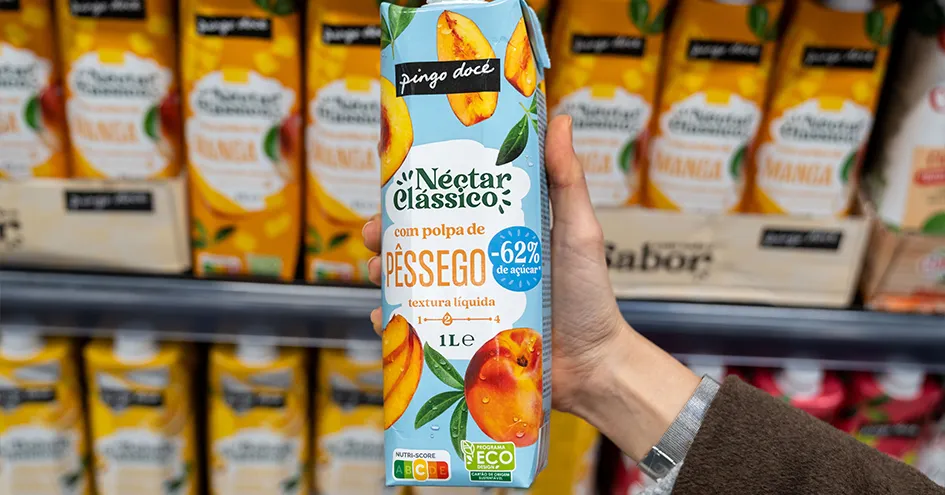
Ara reformulated 27 Private Brand products, with particular emphasis on snacks (such as coated nuts and cereal bars), biscuits and arepas (typical Colombian corn‑based flatbreads). Sugar was the ingredient with the highest tonnes removed (with reductions reaching 56%), while the removal of salt and saturated fats affected a larger number of products.
In addition to nutritional reformulations focused on salt, sugar and fats, the Group has adopted a set of commitments related to eliminating and reducing other ingredients harmful to consumer health in its Private Brand products1.
Among these, a key measure is the replacement of refined cereals with whole grains as the main ingredient in 100% of breakfast cereals for the Companies in Portugal and Poland. Choosing these products offers nutritional benefits, as whole grains may contain more nutrients than refined grains, including higher fibre content. Pingo Doce and Recheio reached this target already in 2024, two years ahead of the deadline set, while progress at Biedronka remained at 92% of the 48 eligible products. This is a labour‑intensive process with suppliers to revise recipes, specifically to use whole grains (wheat, oats, barley, rye and rice) as the primary ingredient.
Ara removed artificial colourings and withdrew several ingredients not permitted under our guidelines in four Private Brand products and in five bakery and takeaway items. At Biedronka, the clean‑labelling commitment continued to be strengthened in 2025, with the removal in 14 products of unnecessary thickeners such as guar gum, xanthan gum and locust bean gum, as well as smoke flavouring and sweeteners.
1 For more information, please refer to “Sustainability Commitments”.