
21. Organisational Charts Concerning the Allocation of Powers Between the Various Corporate Boards, Committees and/or Departments Within the Company, Including Information on Delegating Powers, Particularly as Regards the Delegation of the Company’s Daily Management
Chairman of the Board of Directors
The Chairman of the Board of Directors, according to the Board of Directors’ Regulations, in addition to the institutional representation of the Company, has a special responsibility for managing the respective meetings, for monitoring the action taken on the decisions made by this body, for taking part in the meetings of other committees set up by the Board of Directors and for defining the overall strategy of the Company.
Delegation of Powers and Coordination of Non-executive Directors
The Board of Directors, by resolution, delegated various duties regarding the day-to-day management of the Company in one Chief Executive Officer who, in the terms of such delegation, is entitled:
to manage all corporate businesses and perform all operations relating to its corporate objectives, included in the scope of its current role, as holding company;
to represent the Company, in court or otherwise, to propose and answer to any lawsuits or engage in any arbitrations, for which purpose it may designate proxies, as well as compromise in, confess or withdraw from any such lawsuits or arbitrations;
to decide on loans or other financial operations to be contracted from the financial market at home or abroad, as well as on the issuance of debt securities within the powers of the Board of Directors and to accept the supervision of the lending entities, all these up to the amount of one hundred million euros and in full compliance with that prescribed in the Articles of Association of the Company;
to decide on the provision of technical and financial support, including through the granting of loans by the Company to companies whose stakes or shares the former holds in total or in part;
to decide on the sale/transfer or lease (as lessor) any movable or immovable assets, including shares, units, quotas and bonds, and in general to decide on any divestments up to the amount of one hundred million euros or, independently of such threshold, whenever such divestment is set out in the Medium or Long Term Plans, as defined below, approved by the Board of Directors;
to decide on the acquisition or lease (as lessee) of any movable or immovable assets, including shares, units, quotas and bonds, and in general to decide on any investments up to the amount of one hundred million euros or, independently of such threshold, whenever such investment is set out in the Medium and Long Term Plans, as defined below, approved by the Board of Directors;
to appoint the individuals to be proposed to the General Shareholders’ Meeting from the companies referred to in sub-paragraph d) above, to fill the roles of the respective corporate bodies, indicating those who will fulfil executive functions;
to approve policies and rules transverse to the Companies of the Group, such as procedure manuals, regulations and service instructions, maxime, those concerning (i) Human Resources, (ii) Operational Control, (iii) Food Safety and Quality Control, and (iv) Reporting and Investments;
to approve the expansion plans with respect to the activities of each of the business areas, as well as Group Companies forming part of the Group but not included in the business areas;
to approve the organic structure for the Group’s companies;
to decide on the instructions to be given by the Company to the management of its subsidiary Companies with respect to those matters referred to herein, pursuant to and in compliance with the applicable laws.
For the purpose of the delegation of powers, it is considered as being foreseen in the Medium and Long-Term Plans (which are considered to be the activity and investment plans and financial projections on a three-year term), the acquisitions, sales, investments or divestments, the amount of which does not exceed by more than 10% each heading contained in those Plans.
In 2025, the Managing Committee remained in office as the consultative body which, as referred in point 29, has the primary goal of assisting the Chief Executive Officer in the duties delegated by the Board, in relation to the daily management of the businesses within the corporate purpose of the Company.
Nevertheless, pursuant to the terms of its Internal Regulation, the Board of Directors retains authority over strategic matters of management of the Group, in particular those regarding the definition of general policies of the Company and the corporate structure of the Group and those that, due to their importance and special nature, may significantly impact on the business activity of the Group, seeking to ensure the economic, financial and environmental sustainability of the Company’s long-term objectives and an effective contribution for the community at large.
In addition to the delegated responsibilities, the Chief Executive Officer shall submit to the Board of Directors, for approval: consolidated medium and long term plans for Jerónimo Martins Group and for each business area thereof, together with his appraisal, including the activity and investments plans, as well as the three year term financial projections (“medium and long term plans”); budgets, including financial targets to be achieved in the following financial year, for Jerónimo Martins Group and for each business area thereof; accounts and the consolidated results for the Group and for each of the its business areas, any investments not foreseen in the delegation of powers.
The matters referred to in Art. 407(4) CCC are off-limits to the Chief Executive Officer.
Apart from the powers on strategic matters of management of the Group, the Board of Directors has effective control on directing corporate activities by always seeking to be duly informed and by ensuring the supervision of the Company’s management, having implemented mechanisms that ensure such supervision.
To this end, at each Board of Directors meeting the Chief Executive Officer reports on the Company activity since the last meeting and provides any further clarification that the Non-executive Directors may require. All information requested by the Non-executive Directors in 2025 was provided in full and in a timely manner by the Chief Executive Officer.
Additionally, considering that the Chief Executive Officer is, simultaneously, Chairman of the Board of Directors, it was approved by decision of the said Board, a Mechanism for Coordinating the Activities of Non-Executive Directors.
Such Mechanism foresees that the members of the Board of Directors who are not part of an Executive Committee or are not Executive Directors are responsible, pursuant to the terms of Art. 407, paragraph 8 CCC, for monitoring the activity of the Executive Committee or the Executive Director(s), as the case may be, as well as for the damages caused by their acts or omissions when, having knowledge of such acts or the intent to commit them, they do not seek the intervention of the Board of Directors to take the necessary measures.
The monitoring and supervising activity is also carried out by Non-executive Directors through their participation in Specialized Committees and working groups set up by the Company, as well as in the corporate bodies of subsidiary companies.
Still on the terms of such Mechanism, the Executive Director(s) or the Chairman of the Executive Committee, as applicable, as well as Directors charged with a special duty, pursuant to the terms of Art. 407, paragraphs 1 and 2 CCC, shall:
whenever necessary disclose to Non-executive Directors all the relevant information regarding the performance of the delegated powers or the special duty conferred upon them;
answer, within a reasonable deadline, to any information request presented by any Non-Executive Director, within their respective functions, and such information shall also be made available to the remainder members of the Board of Directors.
It is foreseen in the said Mechanism that Non-executive Directors may also meet in ad hoc meetings, convened at the request of any two of them by the Company´s Secretary (who shall inform the Chairman of the Board of Directors about the summons), pursuant to the terms foreseen in the Board of Directors Regulations.
In order to allow for an independent and informed participation of Non-executive Directors in the meetings of the Board of Directors or in the meetings of the Specialised Committees and working groups set up by the Company as well as in the corporate bodies of subsidiary companies they integrate, the Mechanism foresees that the Company’s Secretary shall make available to them the definitive agenda of the meeting and respective preliminary documentation, pursuant to the terms and within the deadlines foreseen in the Board of Directors Regulation.
The Company’s Secretary shall also ensure, according to the Mechanism implemented, the delivery to the Directors, who so request, of a copy of the minutes of the meetings of the Managing Committee as well as a copy of any other minutes of the meetings of corporate bodies or Specialised Committees within the Board of Directors. Moreover, the Company’s Secretary shall, within its duties, provide Directors with all information regarding the resolutions of the Board of Directors or Executive Committee or the decisions of the Executive Director(s).
In accordance with the Board of Directors’ Regulation, performance by executive Board Members of the Company of executive functions in entities that are not part of the Jerónimo Martins Group shall neither affect their availability, nor the standards of professional diligence, care and loyalty to which they are bound towards the Company.
Organisational Structure and Division of Responsibilities
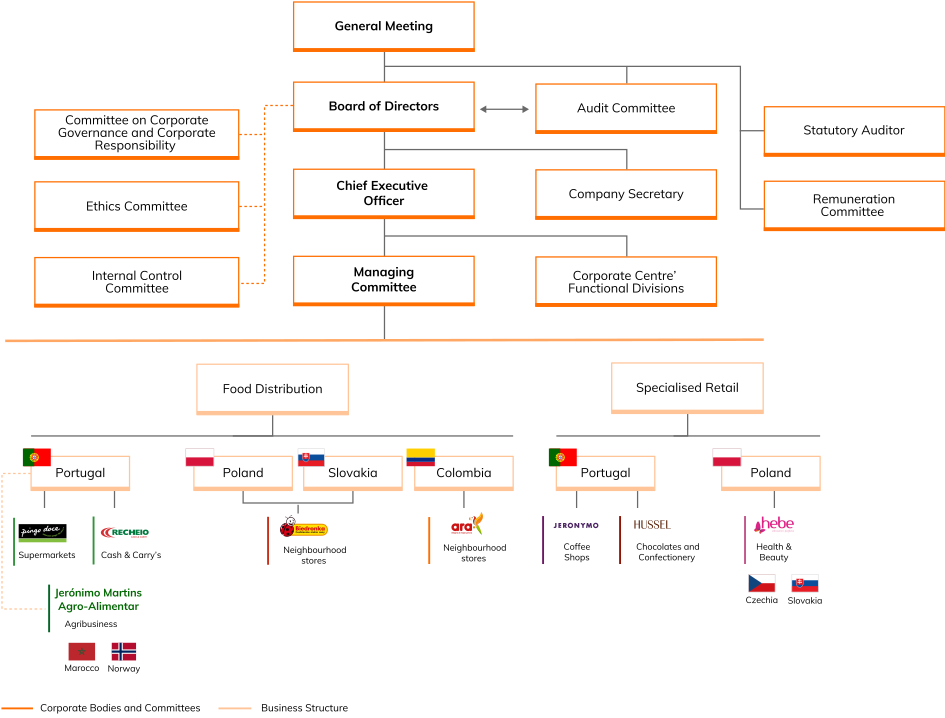
Jerónimo Martins, SGPS, S.A. is the Holding Company of the Group and, as such is responsible for the main guidelines for the various business areas, as well as for ensuring consistency between the established objectives and available resources. The Holding Company’s services include a set of functional divisions which provide support for corporate centre and services to the operating areas of the Group’s companies, in the different geographical areas in which they operate.
In operational terms, Jerónimo Martins is organised into two business segments: i) Food Distribution and ii) Specialised Retail, with the former being the larger segment. The Food Distribution and the Specialised Retail are organised into geographical areas and operating areas (under different brands and formats). The Company also has operations in the agrobusiness segment which serve, essentially, as a support to Food Distribution, mainly in Portugal, guaranteeing the supply and differentiation in strategic categories.
Holding Company Functional Divisions
The Holding Company is responsible for:
defining and implementing the development strategy of the Group’s portfolio;
strategic planning and control of the various businesses and consistency with the global objectives;
defining and controlling financial policies; and
defining Human Resources Policy, with direct responsibility for implementing the management development policy.
The Holding Company’s functional divisions are organised as follows:
Legal Affairs & Compliance |
|
Carlos Martins Ferreira |
|---|---|---|
|
|
|
Internal Audit |
|
Gonçalo Borges |
|
|
|
Corporate Communications and Responsibility |
|
Sara Miranda |
Environment |
|
Fernando Ventura |
Institutional Relations |
|
Rita Fragoso |
Sustainability and ESG Relations |
|
Ana Rovisco |
|
|
|
Food Portfolio Development |
|
Pedro Leandro |
|
|
|
Strategy and Innovation |
|
João Nielsen Sebastian |
|
|
|
Finance |
|
Ana Luísa Virgínia |
Controlling and M&A |
|
Teresa Saraiva |
Sustainable Finance |
|
Conceição Carrapeta |
Tax Affairs |
|
Rita Marques |
Financial Operations and Insurance |
|
Madalena Mena |
Investor Relations |
|
Cláudia Falcão |
Finance Transformation and Reporting |
|
António Pereira |
|
|
|
Chairman and CEO Office |
|
Nuno Aguiar |
Information Security |
|
Nuno Galveia |
|
|
|
Human Resources |
|
Francisco d’Almeida |
|
|
|
Information Technology |
|
João Nuno Magalhães |
|
|
|
Business Support |
|
|
Commercial/Global Sourcing |
|
José A. Nogueira de Brito |
Quality and Private Brand Development |
|
Carlos Santos |
Operations Quality and Food Security |
|
Marta Moreira |
Security |
|
João Carreira |
Environment – Defines the environmental strategy, policies and procedures across all Jerónimo Martins’ Companies by coordinating and guiding the efforts to fulfil their commitments. It seeks to identify opportunities for eliminating and/or minimising negative impacts (on the environment and on the business), both direct and indirect, arising both from the Group Companies’ operations and own-brand products, and from the value chain.
Based on the assessment of environmental impacts, risks and opportunities, trends, the best scientific information available at any given time and the Sustainable Development Goals established by the United Nations, the Group’s environmental strategy prioritises fighting climate change, protecting biodiversity and accelerating the transition to a more circular economic model. Specific objectives, plans and targets are set for each of these areas, and the respective degree of implementation and progress is reported periodically and publicly.
The main commitments and actions carried out in 2025, as well as the results achieved, can be found in the “Sustainability Statement”, being worth of highlight:
the update of the assessment of financial risks and opportunities arising from climate change;
the preliminary assessment of impacts, risks, and dependencies related to nature;
the definition, through the Ellen MacArthur Foundation’s Global Commitment initiative, of the 2030 targets to increase the circularity of private brand plastic packaging of the Group’s Companies.
Legal Affairs & Compliance – Ensures ongoing legal assistance to the Company, preparing contracts, opinions and studies, assisting the Board of Directors in decision making, implementing risk planning policies and giving support to other functional divisions. It also ensures the necessary coordination between the legal departments of subsidiaries in the different jurisdictions in which they operate.
In the area of Compliance, this Division is responsible for designing and coordinating the implementation of mechanisms that ensure regulatory compliance in various areas, including capital markets, competition, business practices, data protection, and anti-corruption, as well as providing ongoing support to the various companies in these matters to safeguard the Group’s value and operations, reinforcing its commitment to sustainable development principles.
In particular with regard to data protection, and in close collaboration with data protection officers, this Division is responsible for (i) monitoring compliance with applicable legislation, (ii) supporting companies in the prevention, assessment, and mitigation of privacy risks, and (iii) defining and implementing policies, procedures, and methodologies across all Group companies. In 2025, continued to focus its activities on (i) monitoring personal data processing activities to strengthen and implement appropriate controls, (ii) overseeing relevant projects to ensure compliance, and (iii) communicating and training employees on data privacy matters.
Regarding corruption prevention, the Division is responsible for (i) identifying the main legal obligations and risks to which companies are exposed and (ii) supporting companies in implementing the most suitable prevention and mitigation mechanisms to comply with these legal obligations and address risks. In 2025, the Group’s compliance program in this area was enhanced, primarily through (i) reviewing, defining, and implementing procedures relevant to corruption prevention and related offenses, (ii) reviewing processes in areas more exposed to risk, and (iii) conducting training and communication activities to educate and raise awareness among employees about risk situations, as well as the procedures and measures to prevent and mitigate them.
Internal Audit – Assesses the quality and effectiveness of the internal control and risk management systems (both operational and non-operational) that are set by the Board of Directors, ensuring their compliance with the Group’s and each business unit’s procedures, as well as ensuring compliance, namely, with the law, regulations, rules and policies applicable to the respective operations.
This division reports hierarchically to the Chairman of the Board of Directors and functionally to the Audit Committee. The activities carried out by this functional division are referred in point 50.
Commercial/Global Sourcing – Responsible for proposing, coordinating and implementing the global procurement strategy, and global sourcing policies, in the different geographies where the Group operates.
Procurement, particularly of agri-food products, is becoming increasingly complex, as a series of trends are emerging in the international context that have a major impact on international supply chains and the production sites of these types of goods. Examples include geopolitical tensions, climate change with an increase in the number of extreme phenomena, the increase in the world population, the globalization of consumer habits, or the scarcity of certain commodities. This last trend has also been impacted by increasing limitations on intensive agricultural and livestock production, imposed by regulators, NGO’s, analysts and consumer groups.
All of these trends, many of which already have a current and significant expression, and are expected to worsen over the next 3 years, should continue to guide the Global Sourcing strategy of the Group companies, with the vision of prioritizing the following 3 axes:
Ensuring the supply of the main agri-food commodities – guarantee availability of volumes and protect their sources of supply;
Protect the profitability of operating companies – guarantee the best purchasing conditions, based on leveraging volumes;
Buy in a more responsible and sustainable way, developing the group of strategic suppliers for the Group in the areas of Private Brands and Specialized Perishables, with a view to continuous improvement in terms of quality, food safety and compliance with ESG criteria, in the areas environmental and social.
Based on this vision, Global Sourcing’s main mission is to conduct and lead the coordination and integration of the commercial departments of the various operational companies, in pursuit of the following main activities:
Coordinate and implement international negotiations with selected global suppliers;
Plan and execute the annual commodity Global Tenders plan;
Deepen technical knowledge of global food commodity markets and development of costing models for essential products;
Develop the park of international suppliers of quality food products;
Analyse, propose and coordinate the implementation of new procurement models for fresh agri-food products, with a focus on fruits and vegetables, bringing the Group operating companies closer to the producers and shortening supply chains;
Promote the sharing of know-how and information between different geographies;
To promote the cross-country development of private label brands within the Group, with a view to leveraging the innovation and differentiation efforts made in one company across all companies, with lower costs and shorter time-to-market;
Develop global brands (to be potentially used by all Group operating companies) in specific product categories;
Harmonize the internal standards and procedures for procurement, supplier selection and price negotiation, applicable in all Group operating companies, with integration of ESG criteria into the respective decision-making processes;
Anticipate and support the preparation of all Group operating companies for the impacts on their sourcing activity of new relevant regulatory frameworks, particularly in the E.U.
Reinforcing the emphasis on social and environmental sustainability criteria introduced in the decision-making process of global tenders, Global Sourcing also takes as a priority in its actions:
Coordinate monitoring, control and decision-taking following the results of the Group’s suppliers within the environmental and social performance audit and rating programs. This activity also includes mapping the risk of the Group’s suppliers, with emphasis on private label brand products and perishables.
Corporate Communications and Responsibility – Ensures the strategic management of the Jerónimo Martins brand, promoting and strengthening its reputation across all areas of the Group’s activity. Defines and implements the Group’s sustainability strategy and policies, maintaining ongoing dialogue with different internal and external stakeholders to manage the balance between economic prosperity, social development and environmental protection.
Controlling and M&A – The division of Financial Controlling coordinates and supports the preparation of the Strategic Plans’ consolidated financial statements, which are the basis for the strategic decision-making by the Company corporate bodies.
It has a control function, monitoring the performance of the different business units of the Group and identifying eventual deviations from the plans and budgets. It thus provides the Managing Committee with relevant information and proposals to guarantee corrective measures that allow the defined strategic objectives to be achieved.
It also makes a financial validation of all investment projects that are relevant for the Group, providing support to the Managing Committee for its approval and monitoring.
In 2025, it maintained the support and monitoring of the performance of the business units and of the development of the Group’s medium and long-term strategic plans, which are essential to the valuation and protection of the Group’s assets.
In the Mergers and Acquisitions component, all the Jerónimo Martins Group’s inorganic growth opportunities, including partnerships, are analysed and evaluated, in the sectors and geographies where the Group operates. This process is conducted in close collaboration with the tax, legal and different teams of the different business units, as well as with external advisors. For each opportunity, the Management is provided with a complete report of the analysis carried out, which supports decision-making.
Food Portfolio Development – The food portfolio development area emerges following the need to monitor the new consumer trends and to anticipate and limit the impacts from the disruption and strong challenges that affected the food manufacturing industry over the last few years, namely coming from instability in the raw materials supply chains, increasing regulatory requirements, and a general shortage of funding, which are pressuring small and medium-sized suppliers that are so important to the Jeronimo Martins Group.
The Group’s ambition to continue growing implies taking a very close look at the food industry in order to identify strategic suppliers with support needs where we can make a difference, as well as investment opportunities for a group with the know-how, capabilities and size of Jeronimo Martins.
Working in articulation with Strategy and M&A, this area is thus responsible for:
Monitoring consumer trends and the food industry’s ability to respond;
Continuously assessing vulnerabilities in the food industry supply chain, with a focus on private label producers;
Identifying opportunities for differentiation and value creation in the food industry;
Structuring proposals for the development and expansion of a potential industrial portfolio;
Preparing action plans and monitoring potential M&A, mergers and partnership processes.
Strategy and Innovation – Performs a set of activities aimed at supporting the Group in defining and executing strategic initiatives and identifying innovation opportunities that drive growth and contribute to creating sustainable value for the organization. It is also responsible for ensuring continuous monitoring of the risks to which the Group’s is exposed. These are described in points 52 to 55 of this Report, together with the activities, policies and procedures developed in the Group’s risk management. The work developed can be classified into the following areas:
Strategy – coordination of multidisciplinary projects with global reach designed to analyse and support decision making on growth opportunities that contribute to achieving the Group’s objectives;
Innovation – incorporation of external perspectives, trends and innovative practices within the organization, namely through the establishment of strategic partnerships and acceleration of innovation pilots;
Portfolio development – identification and analysis of investment opportunities that ensure strategic alignment with the organization’s portfolio and objectives;
Trends analysis – research and analysis of the likely evolution of consumer behaviour, major geopolitical and market trends, globally with particular focus on the regions where the Group operates;
Risk monitoring – regular monitoring of the risks to which the Group is exposed and of the main mitigation initiatives, including the preparation of periodic reports to inform the Group’s several Departments and companies;
Strategic planning support – provision of the necessary support to the Group’s several companies and governance bodies in the activities included in the annual strategic planning process.
During 2025 the area was restructured and strengthened in its capabilities, leading and supporting several strategic projects and investment opportunity analyses, while continuing to monitor the latest developments in the sector. Additionally, it also conducted again the annual risk assessment, covering the entire Group, and ensured the main conclusions were shared with the teams involved in the preparation and approval of the strategic plans.
Sustainable Finance – The Sustainable Finance division is responsible for reinforcing and ensure full coordination between financial operations and the Group’s sustainability initiatives and practices, including the introduction of metrics in financial activity and a total alignment in financial and non-financial reporting. It is also responsible for creating incentive mechanisms that aim to support the implementation of more sustainable practices throughout the Group’s supply chain.
During 2025, and under the scope of the Sustainable Finance Framework (SFF) issued in 2024, some new credit lines were negotiated and other converted into debt linked to Sustainable objectives. Working together with the financial area, it was issued a new bond loan, as well as two commercial paper programs, all linked to sustainable targets included in the SFF, in a total amount of 150 million euros. Also under the SFF, two additional supply chain finance credit lines were converted, which now include sustainability metrics for the suppliers benefitting from those, allowing them to benefit from reduced financing costs, indexed to their sustainability practices. It was also made the follow up of the Green Finance from IFC (International Finance Corporation) to Jerónimo Martins Colombia (ARA), as to monitor the achievement of the sustainability targets agreed. Together with the Global Sourcing area, the development of a project that aims to encourage the adoption of best ESG practices in the Group’s supply chain was continued.
Fiscal Affairs – Provides all the Group’s companies with assistance in tax matters, ensuring compliance with legislation in force and in the optimisation of the business units’ management decisions from a tax perspective, in line with principles of responsible governance. It also manages the Group’s tax litigation and coordinates its institutional relations with external consultants and lawyers, as well as with tax authorities, ensuring ethical and transparent practices.
In 2025, it provided specialized technical support in M&A operations and corporate restructuring processes, reinforcing the integration of ESG basis into tax analysis. It continued to monitor legislative changes, particularly the various amendments to personal income tax – IRS – and their implications for employees (such as “IRS Jovem” scheme or the tax incentive for scientific research and innovation) across the Group’s companies in Portugal.
It was also responsible for analysing the impact of EU Directives, namely the initiative known as “Pillar Two”, ensuring compliance with international standards for fair taxation.
Finally, through active participation in national and international associations representing the sector, it contributed to defending the Group’s interests, promoting the clarification and implementation of new legislation, and engaging in public debate on tax rules, always with a focus on transparency and sustainability.
Financial Operations and Insurance – This Division includes Financial Risk Management, as well as Insurance and Treasury Management. The activity of the first area is discussed in detail in points 52 to 55.
Treasury Management is responsible for managing relations with the financial institutions that already undertake, or have the potential to undertake, business with the companies of the Group, ensuring that these entities fulfil the defined criteria, and also ensuring that the best possible conditions are always achieved and ensuring the best possible conditions are contracted for Jerónimo Martins. It also executes treasury planning with the aim of negotiating and implementing, for all the Group’s Companies, the most suitable financial sources according to its cash flow generation profile, or to get the highest return with the lowest risk from the excess cash of the Group.
A large part of the treasury activities of Jerónimo Martins is centralized in the Holding Company, which is a structure that provides services to all other Companies of the Group. The negotiation and management of the main insurance policies of the Group are also negotiated and managed in this division, where lies the responsibility for the relation with the insurance brokers and insurance companies that do business with the Group.
In compliance with the above-described activities, during 2025, credit lines were reinforced which, according to the Financial Risk Management Policy, have to be available up to the limits imposed on it. On what concerns insurance policies, the annual renegotiation of the same was made, reinforcing once again an integrated approach of all geographies where the Group operates.
Quality and Private Brand Development – Responsible for defining, planning, implementing and controlling the policies, procedures, methodologies and rules in the various countries where Jerónimo Martins operates, ensuring the use of the best and most up-to-date practices in this area. This Division is also responsible for managing the JM Molecular Biology Lab.
In 2025, the main activities carried out focused on:
carrying out the defined product and supplier control activities;
review of the supplier checklist taking into account international benchmarks updates;
continuous improvement of Private Brand products by reformulating existing products;
in the largest and fastest anti-fraud related to ingredient species and genetically modified organisms (GMO) ingredients control – carried out in the Molecular Biology Laboratory;
maintaining the certifications in quality and food safety;
upgrade 2.0 of the Quality Management System (QMS) IT tool for all geographies;
revision of the corporate guidelines for Private Brand – perishables, food and non-food products;
maintaining the accreditation of the JM Molecular Biology Laboratory (DNA Lab).
Operations Quality and Food Safety – Responsible for, in the several geographies where Jerónimo Martins operates, ensuring quality and food safety in all perishable products and processes, along the supply chain, in all its steps: producers and suppliers, goods reception and storage, stores, kitchens and fresh dough factory.
For that it defines, plans, implements and controls Group policies, standards and requirements, for products and processes, promoting alignment of local structures and sharing of best practices, always seeking continuous improvement of products Quality and Food Safety and customer satisfaction.
For that, in 2025, the main activities developed were the implementation of a continuous improvement plan for suppliers focused on their performance along the year and in food fraud control, a continuous improvement plan for product through several consumer panels and internal sensory panels and its follow up in stores, maintenance of Quality and Food Safety Certifications, and continuous improvement of Quality management and data analysis tool.
Human Resources – Responsible for defining the strategy and global human resources policies, ensuring the consolidation of the position as a reference employer in the geographies where the Group operates. Within its responsibilities, it ensures compliance with these guidelines and good practices of social sustainability, respecting the specificities of different countries and the unique identity of each company, promoting good practices that reinforce the attraction, retention, and development of talent.
The activities that this functional division carried out in 2025 can be found in “Own work force”.
Investor Relations – Responsible for the communication with investors – whether current shareholders or not, institutional and private, national and foreign – as well as with the analysts who formulate opinions and recommendations regarding Jerónimo Martins’ share price. It is also the responsibility of this Division to co-ordinate all matters related to the Portuguese financial markets regulator (CMVM).
The activities carried out by this functional division can be found in detail in points 56 and 58.
Institutional Relations – Responsible for anticipating trends and potential impacts arising from political contexts and regulatory frameworks, and for identifying opportunities that promote and defend the interests of the Jerónimo Martins Group at national, European and international level, thereby contributing to the continued strengthening of the Group’s reputation and to the preparation and prosperity of its businesses.
The quality of interinstitutional dialogue and external representation, as well as the proper monitoring of political and legislative agendas relevant to the Jerónimo Martins Group and its Companies, largely determine its ability to remain prepared to manage the necessary changes within a global environment marked by high uncertainty and geopolitical volatility, and by increasing risks of crises and disruptions.
The growing influence of the European Union (EU) over its Member States, with legislative, economic and social implications, requires close monitoring of the European agenda – a responsibility ensured by this Department.
The Group’s representation in organisations considered strategic in the geographies where it operates (such as APED, EuroCommerce, Fenalco or POHiD), and whose agendas we seek to follow and influence, is an integral part of the work carried out by the Institutional Relations team. This also includes the internal coordination required for effective information management and for ensuring the participation of the relevant areas of expertise in the appropriate moments and forums
Security Services – Responsible for the implementation of an integrated security strategy, defining and coordinating procedures for the prevention and protection of people and property and intervening whenever thefts, robberies, or other illicit and/or violent activities occur within the Group’s facilities. In addition, through its Audit team, it assesses the quality and effectiveness of in-store security systems, ensuring compliance with internal procedures and applicable legislation.
International cooperation with teams in Poland and Colombia, which report to this Department was strengthened, and two new strategic areas were created: Security Audit Directorate, dedicated to continuous evaluation of systems and processes, and Innovation Directorate, focused on developing technological solutions and high-efficiency protocols, anticipating current and future threat scenarios.
In the Agribusiness sector, focus was maintained on the specific challenges of the various areas covered (dairy, livestock, aquaculture, and fruit and vegetable operations), since there are significant challenges that require robust and tailored solutions in terms of safety.
Information Security – Responsible for planning, implementing and maintaining an information security and cybersecurity management system across all Group Companies, based on risk management and on prevention, detection, response and recovery of incidents.
Information security officers (ISO) in the geographies where the Group operates, as well as those responsible for technology security, report to this division. Together they ensure the implementation of the information security strategy, compliance with applicable cybersecurity legislation and adherence to internal Information Security Policies and Standards. They also support the respective Companies by assessing and mitigating cybersecurity risks associated with projects and activities.
In 2025, the main initiatives included raising cybersecurity and providing employee training, including on the use of Artificial Intelligence tools, strengthening and testing technical and human resources for incident prevention, detection, response and recovery, improving system resilience and preparing for compliance with the NIS 2 EU Directive. This Department maintains close cooperation with national cybersecurity authorities in Portugal, Poland and Colombia.
Information Technology – Responsible for the management of Information Technologies (“IT”), selecting, developing and maintaining technological solutions for all business units. This Department is divided between global teams, which provide services to the various companies of the Group, and local teams, which are integrated into the structures of the respective companies.
The global team is responsible for i) defining and implementing the Group’s global technology strategy, including IT policies, standards and procedures; ii) continuously promote agility and productivity through technology-based innovation; and iii) contribute to the solidity and autonomy of the IT areas of each company, closely monitoring the activities of the different businesses.
In 2025, the global area began preparing the next cycle of investments in its technological infrastructure, including the redefinition of its data center architecture, the selection of a new data center in Bogotá, and the negotiation of new servers in Portugal and Poland.
In addition, it has negotiated, agreed and defined the path for the evolution of its Enterprise Resource Planning (ERP) system, whose implementation will begin in 2026.
Another prominent initiative is the redesign of the data architecture model, which will migrate from a datawarehousing to a datalakehouse model. This initiative will strengthen the efficiency in the use of data and allow its greater exploitation in the context of artificial intelligence (AI) tools.
The use of AI in Jerónimo Martins companies has gained ground in 2025, with the progressive adoption of new global solutions and the launch of multiple pilot projects to test the applicability and efficiency of AI models to different problems and opportunities.
Although the Company used effective technological solutions to assist in the preparation and management of meetings of its corporate bodies, namely meetings of the Board of Directors and General Meeting, artificial intelligence mechanisms were not used as a decision-making tool by its corporate bodies.
Sustainability and ESG Relations – Responsible for coordinating and monitoring the Group’s sustainability strategy, ensuring the integration of environmental, social and governance (ESG) factors into management models, internal processes and decision‑making, as well as the Group’s strategic positioning on these matters. Ensures alignment with the applicable regulatory framework and with the public commitments assumed by the Group. Acts as a liaison with ESG investors, non‑governmental organisations and other stakeholders, ensuring transparent communication aligned with best practices.
It is responsible for preparing the Group’s Sustainability Statement, coordinating the collection, validation and consolidation of ESG information from the various companies and functional areas of the Group. The Sustainability Statement provides detailed information on the Group’s material topics identified through the double materiality assessment, the ongoing sustainability initiatives, and the main policies and measures adopted in relation to environmental, social and governance targets. It also describes the processes established by the Company for collecting and processing ESG data, monitoring relevant risks and defining mitigation strategies. Additionally, the Sustainability Statement, as well as point 53 of this chapter, includes information on how climate change is considered within the organisation and how climate‑related risks and opportunities are factored into decision‑making processes.
Finance Transformation and Reporting – Responsible for optimizing and automating financial processes and tasks, aiming for its modernization and best practices alignment, alongside with the adaptation of systems and technological solutions of support.
Together with the Finance Transformation team, also integrates the Corporate Consolidation and Accounting areas, responsible for the preparation of consolidated financial information in order to comply with statutory and legal obligations and for supporting the Board of Directors by implementing and monitoring the policies and the accounting principles adopted by the Group.
It also supervises the financial reporting of the different Group Companies to ensure that it conforms to the standards, supporting the Companies in the accounting assessment of non-recurrent transactions, as well as restructuring and expansion operations.
In 2025, continued the automation of financial reports, the standardization of administrative and accounting processes. It continued the implementation of a new solution for Consolidation and lease management (IFRS16).
It also ensured compliance with the annual financial reporting of 2024 and the quarters of 2025, in what regards the IFRS (International Financial Reporting Standards), as well as the guidelines issued by ESMA (European Securities and Markets Authority), with regard to the priorities defined for the 2024 annual reports.
Operational Areas
The organisational structure of Jerónimo Martins is aimed mainly at ensuring specialisation in the Group’s various businesses by creating geographical areas and operational areas, thus guaranteeing the required proximity to the different markets.
The Food Distribution business is divided by geographical areas – Portugal, Poland, Slovakia and Colombia – and within these, by operational areas. In Portugal there are two operational areas: Pingo Doce (supermarkets) and Recheio (cash & carry), which also includes the food service division through Recheio Masterchef. In Poland, it has the Biedronka operational unit (food stores), and in 2025 operations under the same brand began in Slovakia. In Colombia it has Ara (food stores).
The Group’s portfolio also includes a business segment dedicated to Specialised Retail, with the operational areas of Jeronymo (cafeterias) and Hussel (chocolate and confectionery shops) in Portugal – having decided, at the beginning of 2026, to discontinue the operations of the latter – and in Poland with Hebe (health and beauty retail), which, in order to support its online and international operation, also operates five stores in the Czech Republic and two stores in Slovakia.
The Group also has companies in the agro business sector, with activities in the areas of dairy products, agriculture, aquaculture, and fruits and vegetables in Portugal and, in the case of aquaculture, also in Morocco, with a primary focus on protecting and differentiating the supply chain of its food distribution operations. It also has investments in Norway, in Andfjord Salmon, a company that produces salmon in an innovative and sustainable way, and, from the end of 2025, also in Norcod, AS, a company listed on the Oslo Stock Exchange, which is dedicated to the production of cod in aquaculture.