The financial markets experienced strong appreciation alongside high volatility throughout 2025, driven by (i) inflationary pressures linked to changes in international trade relations and the imposition of tariffs, (ii) monetary policy decisions, (iii) geopolitical tensions and (iv) ongoing shifts in investors’ risk perceptions.
In the first few months of the year, easing inflation in the world’s major economies and cuts to reference rates by central banks supported a more favourable sentiment. However, sharp corrections – particularly in the technology sector – underscored heightened sensitivity to unexpected developments, including advances in artificial intelligence (AI) and concerns about intensified competition.
Throughout the spring and summer, trade tensions intensified as the US announced successive rounds of tariffs, raising fears of a global economic slowdown and placing pressure on both equity and bond markets. At the same time, geopolitical developments – ranging from conflicts in the Middle East to political uncertainty across several European countries – reinforced risk aversion, prompting investors to shift towards more defensive assets, notably gold and silver, which recorded consecutive all-time highs in the year.
Uncertainty surrounding US trade policy, together with developments in the field of AI, led to more pronounced movements in certain market sectors.
Despite these pressures, several European markets showed resilience, with strong performances in sectors such as banking and raw materials, supported by improved earnings and a gradual recovery in economic sentiment.
In the second half of the year, concerns about US trade policies continued to influence investor behaviour. Even so, certain positive developments – such as the trade agreement reached in July between the US and the European Union – enabled partial recovery, albeit constrained by the need to adjust margins in response to new tariffs on European exports.
In Europe, the ECB’s rate cuts and a strong earnings season supported a more positive trend, although it remained subject to fluctuations driven by trade negotiations with the US and key political events, including German elections and government instability in France.
Monetary policy, economic indicators and statements by US President were perceived as a threat to the independence and credibility of the US Federal Reserve, reinforcing the dollar’s depreciation, which reached its lowest levels in the past three years.
Amid these developments, the Chinese currency gained prominence, closing 2025 at its highest value since 2023 and breaking the seven-yuan-per-dollar mark. This reflects the weakness of the North American currency throughout the year, with the dollar declining against most major world currencies.
In December, stock markets saw a slight correction, primarily due to the realisation of capital gains following a year of strong performances. This adjustment, however, did not affect the overall positive trend seen in 2025, in an environment shaped by US trade policies, the prolonged partial US Government shutdown, and persistent geopolitical uncertainty.
Europe closed the year with one of its strongest performances in recent years. The STOXX 600 appreciated by around 17%, supported by positive developments in the banking and raw materials sectors, as well as improvements in the economic environment. The UK’s main index (FTSE 100) stood out by completing its fifth consecutive year of gains, underpinned by attractive valuations and its role as a diversification alternative to tech-heavy markets.
In general, December reinforced the view that markets had demonstrated the ability to absorb significant shocks over the course of the year. Nonetheless, heightened caution is anticipated at the start of 2026, given the accumulation of structural risks, including potential AI-related corrections, the threat of an economic slowdown, and uncertainty regarding US economic policy.
Share description
Listed Stock Exchange |
|
Euronext Lisbon |
||
|---|---|---|---|---|
IPO |
|
November 1989 |
||
Share Capital (€) |
|
629,293,220 |
||
Nominal Value |
|
1.00 € |
||
Number of Shares Issued |
|
629,293,220 |
||
Symbol |
|
JMT |
||
Codes |
|
ISIN |
|
PTJMT0AE0001 |
|
Reuters |
|
JMT.LS |
|
|
Bloomberg |
|
JMT PL |
|
|
Sedol |
|
B1Y1SQ7 |
|
|
WKN |
|
878605 |
|
The Jerónimo Martins Group’s sustainable performance, and its contributions to economic prosperity and social development, have received international recognition with inclusion in more than 180 sustainability indices, including Climate Europe, Europe Sustainable 100, CDP Environment ESG Eurozone, Euronext indices, FTSE4Good Developed and FTSE4Good Europe and several MSCI (Morgan Stanley Capital International) indices, Solactive and STOXX.
In 2025, the Group achieved an important milestone, after being assessed by CDP (Disclosure Insights Action), an independent entity, with the top score (A) as recognition of its good sustainability practices in the programmes Climate Change, Water Security and in managing the commodities most associated with deforestation risk (Forests) – palm oil, paper and timber, beef and soy. It is the first time worldwide that a food retailer has achieved such a distinction (triple A), securing the Group inclusion in an exclusive group of 23 global companies that have achieved the highest rating across all three categories assessed by CDP. In addition, the distinction recognises transparent reporting.
More information about Jerónimo Martins’s listing in these and other relevant indices is available on the Sustainability section of our website.
Capital structure
For information on the structure of Jerónimo Martins’s share capital, please see Section A – Shareholder Structure of this Annual Report.
PSI performance
The Portuguese stock market performed well throughout the year, although sometimes lagging behind the pace seen in Europe. The PSI saw moments of strong volatility – notably in April due to intensification of the “trade war” – alongside periods of recovery and appreciation, benefiting from the appeal of a traditionally defensive and dividend-oriented market.
At the same time, Portugal also continued to consolidate its financial credibility. The main rating agencies maintained a positive outlook, reflected in two upward revisions of the sovereign rating, first by S&P, which raised it to “A”, followed by Fitch, which upgraded the rating to “A” with a stable outlook. These decisions highlighted the consistent trajectory in reduction of public debt, the maintenance of budgetary balances, economic resilience, and the strength of exports.
In August, the PSI surpassed the 8,000-point mark for the first time since April 2011 and closed the year well above that level. The index posted year-on-year gains above most European counterparts – the highest increase since 2009 – except for the Polish WIG 20 (+45.3%) and the Spanish IBEX 35 (+49.3%), supported by the relative stability of the national economy and the aforementioned upgrades to Portugal’s sovereign rating by the main rating agencies.
As of September, in Euronext’s periodic review, the PSI started to include 16 listed companies, with Teixeira Duarte returning to the main Portuguese index.
The performance of the Portuguese market was bolstered by strong appreciation in the banking and construction sectors. The latter, within the PSI, experienced a period of exceptional growth. Approval of the 2026 State Budget, in which the government reaffirmed its commitment to moving forward with previously planned structural projects – including the high-speed railway, the expansion of Lisbon and Porto airports, and the development of port concessions – served as a catalyst for a significant increase in prices.
In December, the PSI index closed at 8,263.65 points, up 29.6% compared to the same period in 2024.
In short, and despite the challenging political environment – with the fall of the government and subsequent snap elections – the Portuguese market showed resilience, reflecting confidence in institutional stability and continuity in macroeconomic policies.
Jerónimo Martins share price performance
The most significant movements in Jerónimo Martins’s share price in 2025 reflected, above all, the market’s reaction to quarterly results, adjustments to investor expectations on food consumption trends and the impacts of the substantial wage increases, while operating in highly competitive markets, particularly in Poland.
The year closed with a share price of 20.26 euros, representing a 9.8% increase compared to the previous year’s closing price.
During 2025, the volume of transactions on Euronext Lisbon was around 172 million shares (19% less than in 2024), corresponding to a daily average of around 676 thousand shares. The average share price was 20.78 euros (up 10.1% year-on-year).
Jerónimo Martins shares represented the equivalent of 8.8% (that is, approximately 4 billion euros) of the total number of shares traded on the PSI.
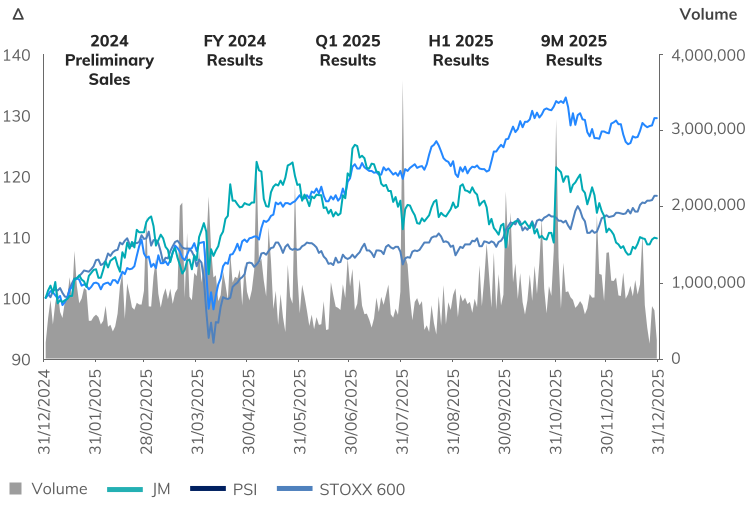
In terms of market capitalisation, Jerónimo Martins ended the year in third place, with 12.7 billion euros (11.6 billion euros in 2024), and a relative weight of 10.1% in the index (compared to 11.5% in 2024).
The Company is one of the three Portuguese companies listed on the Euronext100 index, slightly decreasing its weight to 0.28% (from 0.32% in 2024).
Analysts
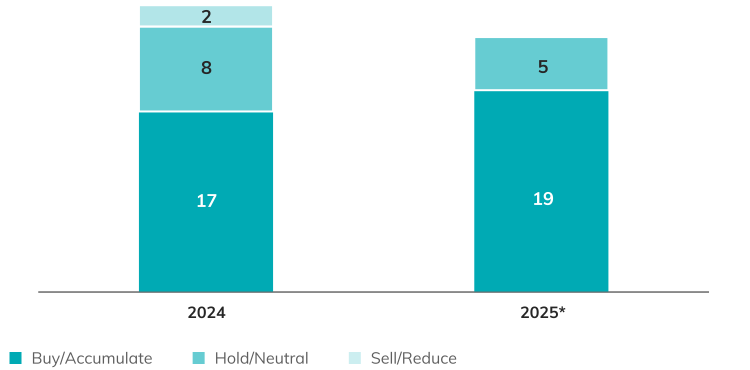
Since August 2025, there have been 25 analysts actively covering Jerónimo Martins shares.
The average target price attributed by these analysts was 25.16 euros, 24.2% above the closing price on 31 December 2025 and 18.7% above that of the previous year.
The evolution of recommendations and price targets issued by the various institutions is available on our website.