
Social criteria related to labour aspects are included in our food safety and quality supplier selection audits. These aspects are further complemented by our social monitoring audits1 of perishables and Private Brand suppliers.
Social audits are carried out by an external entity, with the selection of suppliers to audit being based on the following criteria:
the volume of purchases made by our Companies (more than one million euros in the 2024-2026 period);
the results of previous audits;
the significance of the social impacts of suppliers’ activities;
the social risk of the product and/or the country of supply2.
We use three social audit schemes aimed at incorporating aspects related to high-risk sectors: primary production, operations at sea, and the manufacturing industry. Over 125 requirements are assessed across the following 13 dimensions: prevention of child labour, prevention of forced labour, prevention of discrimination, safeguarding the right of association, contractual terms, working hours, wages and benefits, health and safety at work, emergency preparedness, compliance monitoring, business ethics, protection of human rights, including criteria we consider to be of “zero tolerance”, and protection of surrounding communities3.
The overall score determines five distinct levels of compliance: Excellent, Very Good, Good, Satisfactory and Inadequate.
During audits, interviews are conducted with a representative sample of the audited company’s workforce, including employees from vulnerable groups – such as migrants or temporary workers – as well as those identified during the visit as being at social risk. Interviews are always conducted abiding by the principles of confidentiality and non-retaliation4.
A personalised corrective action plan was presented to and discussed with all suppliers, including those without critical nonconformities, requiring a mandatory response within 12 months at the most, depending on the level of severity. During this period, additional contact is established with the supplier to review progress in the implementation of the plan.
Suppliers evaluated with the “Inadequate” level are regularly contacted to confirm implementation of the corrective action plan. In subsequent years, suppliers are reassessed either on-site or remotely. Where no evidence of progress is found, the business relationship may be suspended, as per our Sustainable Purchasing Policy.
In 2025, we conducted on-site audits of 64 direct suppliers in Portugal, Poland and Colombia (45 more than in 2024). Of the suppliers audited, nine held social certifications – such as Sedex SMETA, Global G.A.P. and Fairtrade – which, based on our equivalence system, were converted into audit.
Social audits - distribution of suppliers of perishable goods, private label and exclusive brands, by performance levels
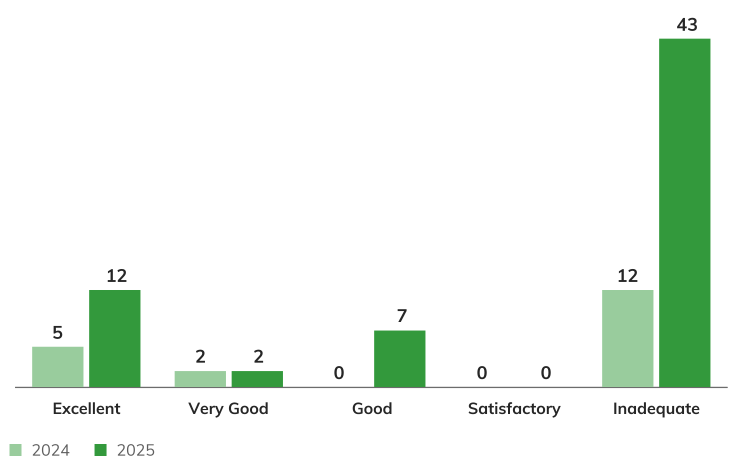
Thirty-one suppliers previously classified as “Inadequate” were re-audited, of which seven were reassessed with the “Excellent” level, two as “Very Good” and one as “Good”. The other 21 suppliers continue to be monitored by our local teams as they maintained their score of “Inadequate”.
1 The social audits we conduct assess compliance with national and international laws and take into consideration the good practices shared by the Sustainable Supply Chain Initiative of The Consumer Goods Forum.
2 As set out in the List of Goods Produced by Child Labour or Forced Labour developed by the Bureau of International Labour Affairs (ILAB). To learn more, visit the ILAB website.
3 There are up to 26 critical criteria depending on the audit scheme used – primary production, operations at sea and processing industry – which focus on the prohibition of child labour and proper age control; prohibition of forced labour and the existence of an employment contract with clear definitions of duties and remuneration; guarantee of freedom of movement, prohibiting the retention of workers’ documents; compliance with the maximum number of working hours and the obligation to grant rest days, remuneration and auditable records thereof; prohibition of acts of discrimination; existence of work insurance, equipment and emergency assistance mechanisms (medical or firefighting), respect for local natural resources (land and water), and establishment of a process of free, prior and informed consent (FPIC) with local communities, among others. In the case of audits for primary production or operations at sea, due to the specificities of migratory contexts and seasonality, these criteria include ensuring proper repatriation in cases of contract termination.
4 For more information on these processes, see “Workers in the value chain”, of this chapter.