
Establishing and maintaining relationships with local suppliers helps strengthen the regional economy by stimulating business activity in the communities where we operate and promoting job creation. Geographical proximity to suppliers also helps to streamline the supply chain and enhance operational efficiency. Working with local partners also reduces delivery times and ensure fresher products with longer longevity and higher quality, which translates into direct benefits for consumers and the organisation’s overall performance. From an environmental perspective, reducing transport distances helps cut carbon emissions linked to transportation, particularly air and sea freight.
Food products acquired from local suppliers (2025)
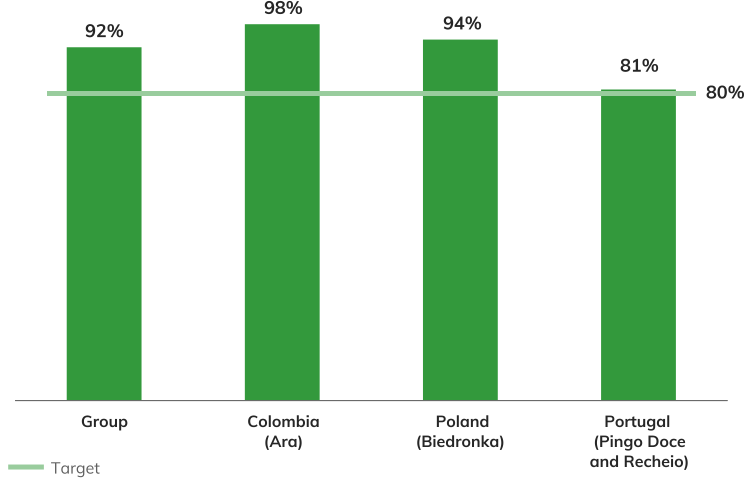
These are the benefits that have motivated us, for over a decade, to maintain our commitment that at least 80% of food purchases by our food distribution companies are made from local suppliers1. These actions are reinforced annually, prioritising domestic agricultural production in the countries where we operate.
This is the case of Biedronka in Poland, which has maintained a direct purchasing programme supporting small local producers since 2021. Launched with just 60 participants, by 2025 the programme had expanded to include more than 260 active producers. In the year, over 268 million food items were delivered to Biedronka stores, 50% more compared to the approximately 180 million delivered in 2024.
At Ara, of note is the “La placita de Ara” (Ara’s little market) initiative, which features an in-store section, at store front, dedicated to selling fruit and vegetables bought directly from local producers. In 2025, more than 100 producers took part in this initiative, resulting in the sale of around 80,000 tonnes of products sourced from local producers, 11% more that in the previous year.
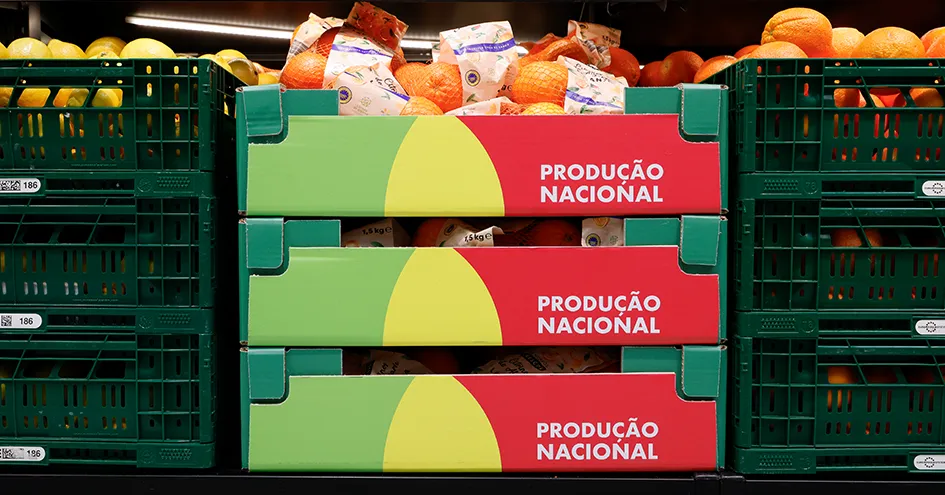
Our Companies in Portugal have also continued to strengthen their relationship with local producers. Pingo Doce promotes local products on its social media pages, in-store, on packaging and in specialised perishables leaflets. In 2025, the Company purchased more than 16,000 tonnes of apples, mini apples, mini pears, cherries, chestnuts and kiwi fruit, despite a decline in kiwi fruit production due to adverse weather conditions.
All our food distribution Companies also promote local and seasonal products for sale using a range of communication formats, including in-store communication, leaflets, television campaigns, and digital channels. Additionally, we use stickers on Private Brand products to highlight:
the incorporation of 100% Portuguese raw materials and/or production at Recheio;
the origin, with the “100% Nacional” (100% Portuguese) or “National Product” sticker at Pingo Doce, “Polski Produkt” (Polish Product) sticker at Biedronka and “Hecho en Colombia” (Made in Colombia) sticker at Ara.
1 More information on purchases from local suppliers in Private Brands and perishables products, such as meat, fish, fruit and vegetables, bakery/pastry and flowers, is available on our corporate website.