
We carry out food quality and safety audits not only when selecting new perishables and Private Brand suppliers, but also to monitor current suppliers. These audits evaluate aspects such as hygiene and food safety conditions, traceability and labour-related aspects1.
Selection audits of potential suppliers are mandatory; however, this requirement is waived where potential suppliers hold food safety certifications approved by the Global Food Safety Initiative (GFSI)2, unless the risk presented by a potential Private Brand supplier is above “Low”, in which case an on-site audit is conducted.
The frequency of monitoring audits, within the scope of which action plans are presented to suppliers after they have been carried out, is defined based on criteria that determine the supplier’s performance, taking into account:
the level of perishability of the product and/or the history of risk assessments per supplier;
the results of analytical checks, rejections and complaints about the products supplied;
the results of previous audits;
the existence of GFSI-approved certifications.
The outcome of this assessment determines the score awarded to a supplier, as follows:
Private Brand |
|
Specialised perishables |
|---|---|---|
|
|
|
|
|
2025 |
|
2024 |
|
Δ 2025/2024 |
||||||
|---|---|---|---|---|---|---|---|---|---|---|---|---|
Poland |
|
|
|
|
|
|
||||||
Perishables2 |
|
1,073 |
|
1,231 |
|
-12.8% |
||||||
Private Brand |
|
439 |
|
467 |
|
-6.0% |
||||||
Slovakia |
|
|
|
|
|
|
||||||
Perishables2 |
|
45 |
|
n.a. |
|
n.a. |
||||||
Private Brand |
|
38 |
|
n.a. |
|
n.a. |
||||||
Portugal |
|
|
|
|
|
|
||||||
Perishables |
|
824 |
|
924 |
|
-10.8% |
||||||
Private Brand |
|
208 |
|
188 |
|
+10.6% |
||||||
Colombia |
|
|
|
|
|
|
||||||
Perishables |
|
220 |
|
209 |
|
+5.3% |
||||||
Private Brand |
|
260 |
|
245 |
|
+6.1% |
||||||
Total |
|
|
|
|
|
|
||||||
Perishables2 |
|
2,162 |
|
2,364 |
|
-8.5% |
||||||
Private Brand |
|
945 |
|
900 |
|
+5.0% |
||||||
|
||||||||||||
In 2025, we conducted 5% less food safety and quality audits to our suppliers compared to 2024. The decrease in audits is due to the lower number of requests to assess new suppliers and the good results obtained in the previous year by the existing suppliers, which enabled to reduce the frequency of follow-up audits.
In the meat, farmed fish and eggs categories, food safety and quality audits also include animal welfare criteria.
In the meat category, audits can focus on both primary production and the slaughterhouses with which our Companies and respective suppliers work. General aspects are adapted for different meat categories (with specific conditions for beef, poultry, pork, rabbit and lamb), such as conditions on the farm, feed, transport and stunning. These criteria are based on laws in force and assess the implementation of good practices throughout the production process.
Aquaculture audits assess aspects such as daily husbandry conditions, water quality, and oxygen availability – key factors for reducing stress in fish and to promote a healthy development. Specific well-being indicators are also evaluated, including behaviour, appetite, growth rates and signs of illness, enabling early identification of discomfort or health risks. The methods used during transport and slaughter operations are observed (from loading and unloading to stunning), ensuring that the process is carried out in a controlled manner and with minimal impact on the fish’s physical condition.
Audits carried out on the farms of fresh egg suppliers that supply Biedronka’s operations in Poland and Slovakia analyse criteria such as housing conditions, feeding, freedom of movement and access to fresh water, essential for the welfare of laying hens. Pingo Doce and Recheio also assess animal welfare criteria for hens that lay Private Brand fresh eggs. Ara does not sell Private Brand fresh eggs, so these audits are not required.
Audits of direct suppliers of fresh aquaculture fish are carried out according to the Fish Welfare internal checklist, which is based on the aquaculture Global G.A.P. Framework and on laws in force. At Pingo Doce and Recheio, 100% of fresh aquaculture fish were assessed as to these criteria, as around 70% of fresh aquaculture fish suppliers are Global G.A.P. certified. The remaining 30% were included in the animal welfare audits coordinated by our Companies. At Biedronka, suppliers in this category were assessed in 2024, with further audits planned for 2026.
In 2025, a total of 108 animal welfare audits were carried out, 21% more than in 2024. These audits covered:
primary meat production – Ara, Pingo Doce and Recheio
slaughterhouses – Biedronka (Poland and Slovakia), Ara, Pingo Doce and Recheio
farmed fish – Pingo Doce and Recheio
laying hens – Biedronka (Poland and Slovakia)
Animal welfare audits in the meat, egg and aquaculture fish categories - Distribution by measured performance level (2024-2025)
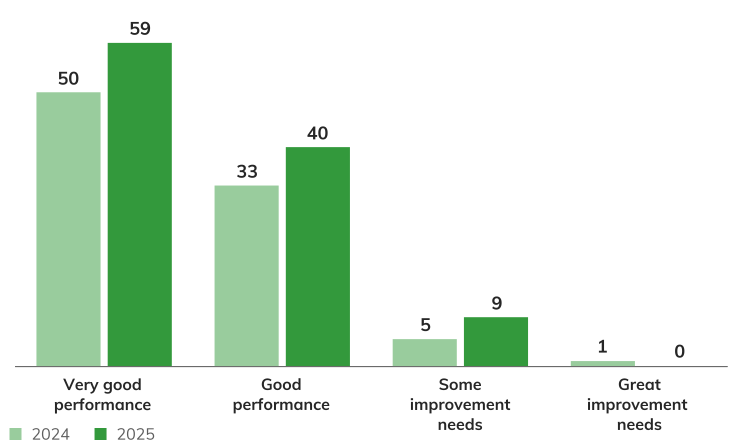
The increase in audits is due essentially to those carried out at slaughterhouses and laying hens farms that supply Biedronka which, in the previous audit, received a performance evaluation of below 95%.
We continue to work with broiler chicken and turkey suppliers in Portugal to encourage certification in accordance with the Welfair™ standard, which is awarded by external bodies. This certification is based on the European Welfare Quality and AWIN® standards and evaluates and monitors the quality of animal welfare on farms, in rearing areas and in slaughterhouses.
2 The Global Food Safety Initiative is a coalition of The Consumer Goods Forum that assesses food safety management systems in supply chains with the aim of ensuring a reliable supply of food products to consumers. Several schemes are recognised by this initiative, including British Retail Consortium (BRC), Global Good Agricultural Practices (Global G.A.P.), HACCP/Codex Alimentarius, International Featured Standards (IFS), Food Safety System Certification (FSSC) 22000, and ISO 22000.