
The year 2025 reinforced the strength of a business story spanning more than two centuries, built on a long‑term vision and a continued commitment to responsible value creation across the entire chain. This consistent journey, combined with the daily work of our teams, was once again recognised internationally: we featured in more than 180 sustainability indices that distinguish our good practices and the positive impact we generate. Below are some of the most relevant scores we obtained in 2025, and the respective progress regarding the two prior assessments (whenever existed):
|
|
2025 |
|
2024 |
|
2023 |
||||||
|---|---|---|---|---|---|---|---|---|---|---|---|---|
|
|
Score |
|
Industry rank/ |
|
Score |
|
Industry rank/ |
|
Score |
|
Industry rank/ |
CDP Climate |
|
A |
|
Leadership |
|
A |
|
Leadership |
|
A |
|
Leadership |
CDP Forests |
|
A |
|
Leadership |
|
A- |
|
Leadership |
|
A- |
|
Leadership |
CDP Water |
|
A |
|
Leadership |
|
A- |
|
Leadership |
|
A- |
|
Leadership |
Ecovadis |
|
78/100 |
|
Silver | Top 15% |
|
– |
|
– |
|
– |
|
– |
Global Child Forum |
|
9.0 |
|
3rd |
|
8.5 |
|
3rd |
|
8.9 |
|
1st |
ISS ESG |
|
B- |
|
Prime |
|
B- |
|
Prime |
|
C+ |
|
Prime |
MSCI |
|
A |
|
Average |
|
A |
|
Average |
|
A |
|
Average |
Sustainalytics |
|
16.5 |
|
Low risk |
|
16.2 |
|
Low risk |
|
14.1 |
|
Low risk |
WDI |
|
71% |
|
Most transparent |
|
– |
|
– |
|
– |
|
– |
On the environmental front, our performance again stood out on a global scale. For the first time, a multinational food retailer achieved CDP’s triple A – the highest distinction awarded by the leading independent organisation assessing environmental practices. This achievement reflects our actions to combat climate change and deforestation, as well as our approach to water management, also recognizing the transparent way we communicate what we do and what we deliver.
The efforts developed by our Companies and the continuous investment we have been implementing enabled us to substantially reduce our carbon footprint: in 2025, emissions were 18.4% lower than in 2021, our baseline year, even as turnover grew 72.3% over the same period.
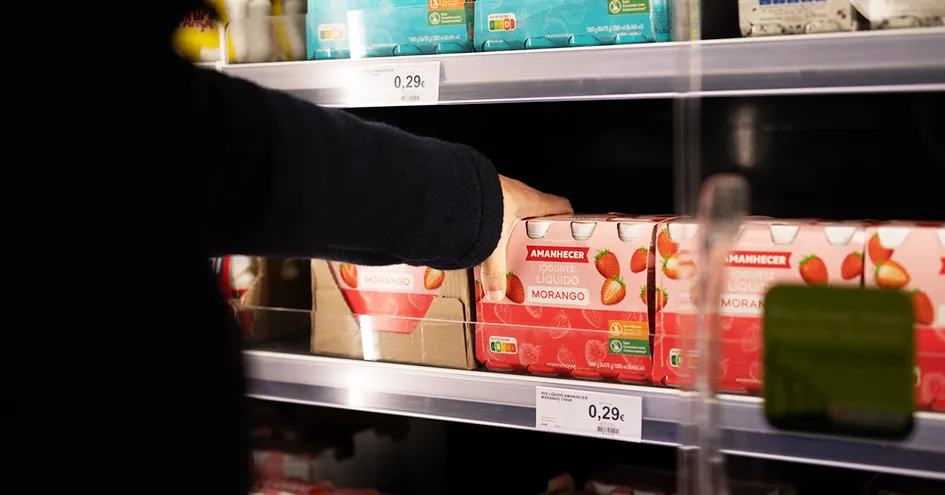
Our energy transition strategy is also delivering results. Energy consumption, per million euros of sales, has fallen 32% compared with 2021, and our commitment to renewable sources is today unmistakable. Besides having photovoltaic panels installed in more than 2,700 locations, over half of the energy we consume is coming from renewable sources.
A portion of these investments has been carried out through sustainable finance instruments, which represented around 29% of our consolidated funding in 2025 (compared with 25% in 2024).
On the social axis, we strengthened our commitment in Colombia with a two‑million‑euro investment aimed at tackling food insecurity and supporting vulnerable groups within the population – particularly children, young people, and mothers. These projects benefited more than 64,000 people.
Overall, support for the communities in greater needs in the countries where we operate reached 91 million euros, over 12% increase versus last year.
As a major employer, we created more than 7,800 jobs and now have almost 148,000 employees representing 86 nationalities. We continued expanding inclusion practices being nearly 3,500 employees with disabilities and impairments in our staff, who represent 2.4% of the total workforce (from 1.6% in 2024).
We also increased investment in our people, with 361 million euros applied to recognition initiatives, 54 million euros in internal social responsibility programmes, and 18 million euros in training.
Food retail, which accounts for more than 98% of consolidated sales, is at the heart of our business, and we work every day to ensure safe, high‑quality products at competitive prices. This commitment translates into ongoing investments in rigorous audits and analyses of our products and suppliers, as well as the promotion of healthier food solutions. In 2025, recipe reformulations avoided the consumption of 320 tonnes of sugar, 275 tonnes of fats and 39 tonnes of salt – without compromising taste or consumer preference. At the same time, we reinforced our contribution to local economies: 92% of the food products we sold were purchased from local suppliers.
The results for 2025 confirm, once again, that our business models – combining committed teams, efficiency-oriented and investment in sustainability – consistently create economic, social and environmental value.
Environmental highlights

Carbon emissions (scopes 1 and 2) reduced by 18.4% compared with 2021.
Energy consumption (per million euros of sales) fell 32% versus 2021.
Photovoltaic solar panels in more than 2,700 establishments.
Packaging materials were reduced by 3.7% (per million euros of sales) compared with 2024.
Social highlights
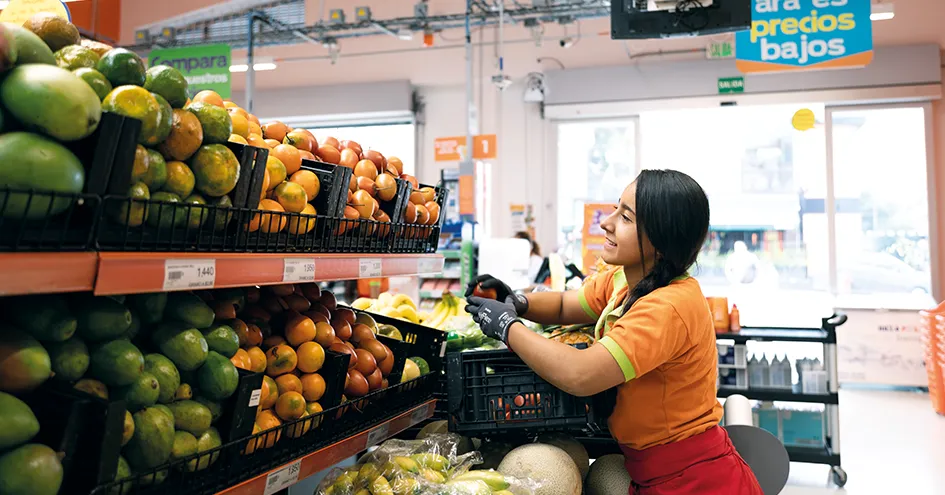
361 million invested euros in employee recognition and 18 million euros in training.
54 million euros allocated to internal social responsibility measures.
Neighbouring communities supported with 91 million euros, over 12% more than in 2024.
320 tonnes of sugar, 275 tonnes of fats and 39 tonnes of salt prevented from entering the market through nutritional reformulations from our Private Brands and perishables products’ ranges.
Governance highlights
More than 118,000 employees (80% of our workforce) have now received training on the Code of Conduct, and more than 31,000 on the Anti‑Corruption Policy.
92% of food product purchases were made from local suppliers.
We paid over one billion euros in taxes and social contributions in the main markets where we have food distribution operations.