
One of the actions implemented to strengthen sustainability across the value chain is the adoption of recognised certifications in Private Brand and perishable products and packaging. These certifications, managed by external and independent entities, ensure the application of sound environmental practices, guaranteeing that no deforestation or conversion of High Conservation Value ecosystems occurs, and that production processes comply with strict pollution‑prevention and mitigation standards. In addition to the environmental component, these certifications incorporate stringent social criteria, ensuring respect for human rights – namely the absence of child or forced labour – and promoting fair remuneration for producers throughout the supply chain.
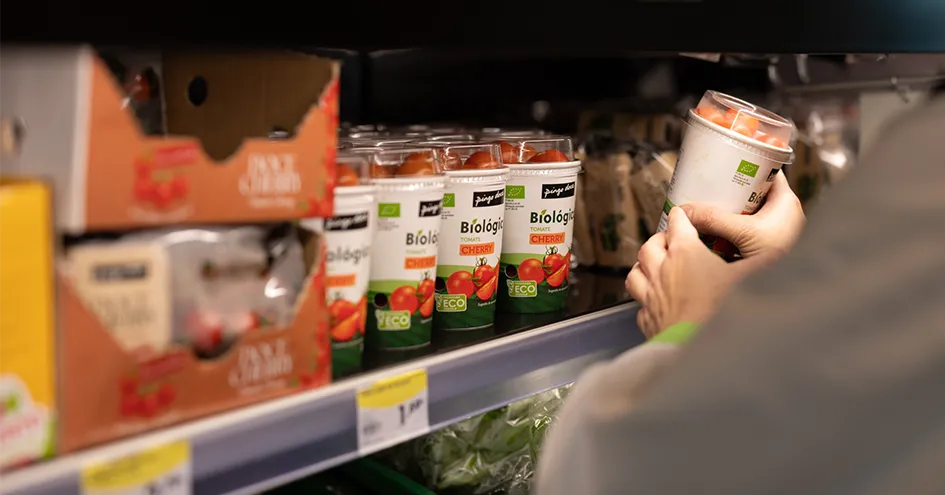
A key action involves the commitment to clearly communicate the sustainability characteristics of products to consumers. As such, the presence of the specific certification symbols at the point of sale is prioritised, enabling customers to easily identify the attributes that distinguish these products from others that may appear similar.
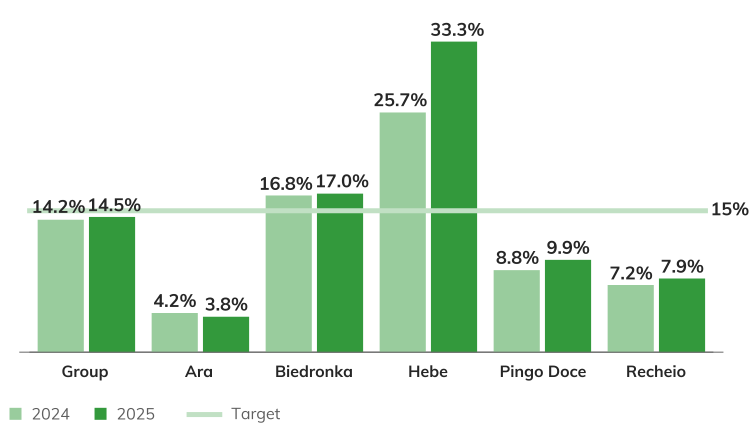
In 2024, a commitment was established for the 2024-2026 period: “to increase sales (in euros) of Private Brand and perishable products and/or packaging with sustainability certification to at least 15% of total sales (in euros) in these categories by 2026.”
Throughout 2025, efforts were strengthened to ensure progress towards this commitment, resulting in a 0.3 p.p. increase compared with 2024. This progress corresponds to 14.5% of sales of products and/or packaging with sustainability certification in 2025.
In parallel, there was an increase in the number of certified references, reaching 2,464 in 2025, representing a 31% increase compared with 2024.
Sales (euros) of Private Brand and perishable products with sustainability certification (2025 vs 2024)
The most common certifications include:
-
paper and wood fibres sourced from sustainably managed forests, with FSC® and PEFC being the most prevalent;
-
OEKO‑TEX Made in Green for textile products, ensuring implementation of leading social and environmental practices;
-
organic certification for food products;
-
Rainforest Alliance, applicable to agricultural raw materials.
To achieve the 15% target, we will continue promoting the adoption of sustainable practices among our current suppliers and identifying new partners that already meet these requirements. In parallel, we ensure that the majority of consumers have access to products with these characteristics, contributing to their wider availability. In 2025, 684 certified products were launched, reflecting ongoing efforts to identify committed suppliers and collaborate to ensure adherence to certification criteria.
This commitment to sustainability extends beyond product certification: it also encompasses the promotion of circularity and the extension of product life cycles. As part of Biedronka’s commitments for the 2024-2026 period, we ensured the extension of warranties to three years across nine categories of electrical and non‑electrical non‑food products. Of the 580 products covered, 539 already benefit from this extended warranty, representing 93% of the commitment’s scope.
This initiative reinforces consumer trust and is aligned with our efforts to reduce environmental impact by keeping products in use for longer periods. In addition to warranty extensions, we continue to develop actions promoting circularity, including partnerships for responsible recycling and awareness campaigns encouraging more sustainable product use. Together, these measures consolidate our commitment to the circular economy and a more responsible retail model. More information on these initiatives can be found in “Resource Use and Circular Economy”.