
Paper and timber
The way we use virgin paper and timber fibres in our Private Brand and perishable products and packaging is in line with Element 1 of the FPCoA’s roadmap for paper, pulp and packaging, and its definition of a positive forest. As such, we are committed to not contributing to deforestation, conversion, forest degradation and human rights violations.
To reduce the risk of deforestation associated with our Private Brand and perishable products and packaging, we have implemented a strategy based on three pillars:
progressive incorporation of recycled fibres;
monitoring the origin of virgin fibres at least up to the national level;
use of virgin fibres with FSC® or PEFC sustainability certification.
In 2025, the use of virgin paper and timber fibres in our Private Brand and perishable products and packaging increased by 10% compared with 2024. This is explained by two factors: the global trend of replacing plastic packaging with paper‑based alternatives, and the growing demand for recycled paper and timber fibres, which reduces their availability on the market.
Our commitment is to ensure that the paper and timber used in our Private Brand and perishable products and packaging are not associated with deforestation or the conversion of HCV ecosystems, setting 31 December 2020 as the cut-off date for the cessation of conversion.
In this context, our two main objectives are:
ensure that 95% of virgin fibres used in our products and 80% of virgin fibres used in our packaging have a sustainability certification such as FSC® or PEFC by the end of 2026;
ensure that 100% of virgin fibres used in our products and packaging hold FSC® or PEFC sustainability certification by the end of 2030.
The use of virgin paper and timber fibres in Private Brand and perishable products in the three main countries where we operate (Poland, Portugal and Colombia) is assessed annually. Accordingly, we calculated the DCF consumption of these fibres assuming that:
countries identified by the FPCoA as free from deforestation and conversion are considered negligible risk;
in countries identified as having a high risk of controversial sources, FSC® or PEFC sustainability certification schemes are considered DCF.
Progress in 2025
The use of paper and timber fibres in Private Brand products and packaging in Colombia, Poland and Portugal is assessed annually. Our progress is measured in accordance with the guidelines set out in the CGF’s Pulp, Paper & Packaging Guidelines.
In 2025, the Group used a total of 414,574 tonnes of virgin and recycled paper and timber, covering 100% of Private Brand and perishable products and packaging. Around 44% of our fibre consumption comes from recycled materials. As for the virgin fibres, which account for around 56% of the total, approximately 92% had FSC®, PEFC or SFI sustainability certification. This figure is in line with our goal of ensuring 100% certification by 2030.
Also in 2025, we were able to trace the origin – at least to country level – of around 95% (5 p.p. more than in 2024) of the virgin fibres used. This exercise revealed that around 11% (5 p.p. less than in 2024) of our virgin paper and timber fibre consumption originated from countries with non‑negligible or unknown deforestation risk. We mitigated this risk by incorporating raw material with FSC® PEFC or SFI certification, which represented 76% of the total virgin fibres originating from countries with non‑negligible or unknown deforestation risk.
DCF Status - Paper/timber (2025)
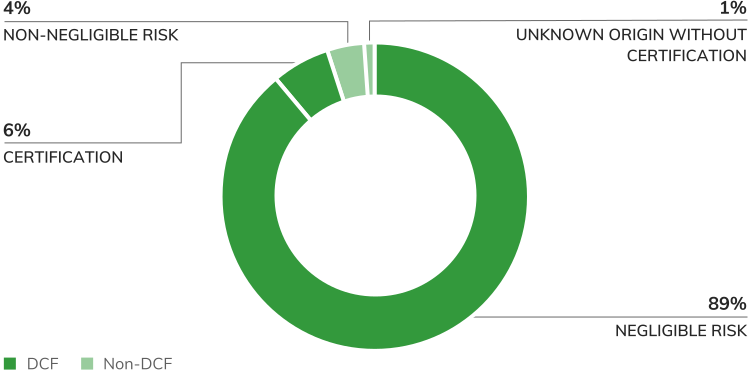
Thus, assuming that:
the countries identified by the FPCoA as being free from deforestation and conversion are considered to have negligible risk;
in countries identified as having a high risk of controversial sources, sustainability certification schemes (FSC® or PEFC) are considered DCF;
we can estimate that 95% (222,578 tonnes) of the total virgin paper and timber fibres used in Private Brand and perishable products and packaging were free from deforestation and the conversion of High Conservation Value ecosystems.
Paper and timber products
In 2025, we used 185,111 tonnes of virgin paper and timber fibres in our Private Brand products, an increase of 8% compared with 2024. This is due to the launch of new products and our sales growth, particularly at Biedronka and Ara.
Around 94% of the virgin fibres used in Private Brand products held FSC® or PEFC certification. We were able to trace 100% of the virgin fibres to country level, which allowed us to identify that around 7% originated from countries with non‑negligible deforestation risk1. However, from this percentage, 81% came from responsibly managed forests, as they carried FSC®or PEFC certification.
This analysis shows that 96% (177,539 tonnes) of the total virgin paper and timber fibres used in products were free from deforestation and the conversion of High Conservation Value ecosystems. Of this amount, 97% (172,612 tonnes) came from negligible‑risk countries, and 3% (4,927 tonnes) held physical certification considered DCF around 94% held FSC® or PEFC certification;
around 7% originated from countries with non‑negligible deforestation risk1 – of this, 81% came from responsibly managed forests, as they carried FSC® or PEFC certification.
Paper and timber packaging
Around 79% (1 p.p. less than in 2024) of the paper and timber fibres used in our packaging are recycled. Of the remaining 21%, which correspond to 49,009 tonnes of virgin fibres, we identified that around 83% held FSC® or PEFC certification. The remaining 27% (31 p.p. less than in 2024) originated from countries with non‑negligible or unknown deforestation risk – of these, 71% held FSC®, PEFC or SFI certification.
Assuming the previously mentioned criteria, we estimate that 45,040 tonnes (92%) meet the DCF requirements. Of this total, 35,852 tonnes (80%) originate from negligible‑risk countries, while the remaining 9,187 tonnes (20%) hold physical certification considered DCF.
As a food retailer, we do not directly purchase the raw materials used in packaging production, which makes this supply chain particularly complex. Nevertheless, the DCF result reflects the joint efforts undertaken with our suppliers to strengthen the traceability of this raw material.
Engagement with suppliers and traders
We have established an ongoing relationship with our Private Brand and perishables suppliers, focused on fulfilling our commitments to fight deforestation. Since 2014, we have worked closely with them to track the use of virgin fibres in our Private Brand and perishable products and packaging (including primary, secondary and tertiary packaging), aiming to identify their country of origin of the virgin fibres. If the country presents a risk of deforestation, our goal is to identify the region of origin. We also evaluate the sustainability certification associated with these fibres, prioritising FSC® and PEFC certification schemes.
All our suppliers are committed to the actions publicly defined in the FPCoA’s Pulp, Paper and Packaging roadmap, and are encouraged to include the same commitments in their own practices. To promote a more responsible supply chain aligned with our sustainability objectives, we conduct an annual survey to monitor each supplier’s progress.
Our priority lies on suppliers that together represent 80% of our total paper and timber consumption, reinforcing the communication about our performance, commitments and policies for a positive future for forests. To increase visibility across the supply chain, we map the origin of our paper and timber, identify the certification schemes used and collect information on other suppliers upstream of our direct suppliers.
We are committed to extending the traceability of our supply chain to the subnational origins (such as region, state or municipality) of this commodity by the end of 2025. We will involve our most relevant suppliers to identify their traders, verify their commitments to fight deforestation and conversion, and promote their alignment with the objectives we have set for our paper and timber supply chain.
1 The countries considered to have a non‑negligible risk of deforestation associated with agricultural production of paper and timber correspond to those defined in the CGF guidelines (Argentina, Indonesia, Malaysia, the United States and Vietnam).