
Beef
Our Private Brand and perishable products containing beef are aligned with Element 1 of the FPCoA roadmap for this commodity. Our commitment is to ensure that the beef present in our Private Brand and perishable products is not associated with deforestation nor the conversion of HCV ecosystems. We have set different cut-off dates in line with existing sectoral agreements, such as the cut-off dates for legal deforestation of Amazonian beef. For any region in Brazil, the cut-off date for illegal deforestation and conversion is no later than 1 August 2008; for zero deforestation and conversion the cut-off date is no later than 1 August 2020.
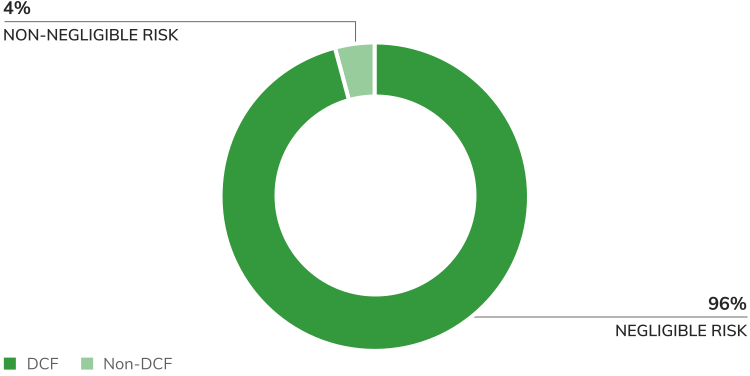
DCF Status - Beef (2025)
We aim to increase the traceability of beef to identify its origin and ensure its sustainability – particularly in countries with a risk of deforestation. In these cases, we encourage our suppliers to adopt policies and commitments that are in line with the principles of the FPCoA, particularly for the prevention of deforestation and the protection of ecosystems. We are also committed to make 100% of beef in our Private Brand and perishable products traceable at least to the country of origin, and, where the risk is not negligible, fully traceable back to the production farm.
Progress in 2025
In 2025, 100% of our beef consumption in Private Brand and perishable products – including offal, leather and tallow – was 40,895 tonnes. As in the previous year, we were able to trace all beef at least to the country of origin, which allowed us to determine that around 4% of our consumption originated from countries where the risk of deforestation associated with beef production is non‑negligible, according to the CGF guidelines.
Although our exposure to this ingredient is very limited, we continue to actively participate in the FPCoA’s beef working group. We collaborate with suppliers and promote information sharing across the supply chain, especially between our direct suppliers and meatpackers located in countries with non-negligible risk, so that they can adopt more sustainable production practices.
Given that countries with negligible risk are considered free from deforestation and the conversion of High Conservation Value ecosystems, we estimate that 96% (39,105 tonnes) of our beef consumption is DCF.
Considering our total consumption in direct sourcing (39,347 tonnes) and complex sourcing (1,548 tonnes), we can see that:
in direct supply chains, 95% (37,566 tonnes) meets the DCF criteria;
in complex supply chains, 99% (1,539 tonnes) of the volumes are aligned with our DCF assumptions.
Engagement with suppliers and traders
We have communicated our policies, commitments and progress in fighting deforestation, the conversion of ecosystems with HCV and the violation of human rights – in line with the FPCoA – to all beef suppliers, raising awareness and encouraging them to adopt the same commitments in their operations. This communication was reinforced with all beef suppliers from higher-risk countries, namely Brazil, and other South American origins, such as Argentina and Paraguay.
In 2025, we identified the no deforestation policies of our main suppliers and assessed whether they had mechanisms in place to control deforestation and conversion – including cut-off dates and adequate traceability systems for their direct and indirect suppliers.
We also mapped our consumption of this ingredient from Argentina and Paraguay down to the slaughterhouse level. For beef originating in Brazil, suppliers and meatpackers were asked whether they have a beef purchasing control system in place, in line with the Monitoring Protocol for Cattle Suppliers in the Amazon and the Voluntary Monitoring Protocol for the Cerrado, and whether these controls also extend to their indirect suppliers.
The main meatpackers responsible for our beef consumption were evaluated by CDP – Disclosure Insight Action (formerly Carbon Disclosure Project). In 2025, meatpackers rated A under the Forests programme accounted for 30% of our consumption. Those rated A- made up 1%, while 55% were rated B. Around 15% were not assessed.
All meatpackers in our supply chain with operations in Brazil have been informed about the FPCoA beef roadmap and the Guidance for Forest Positive Suppliers of Cattle Derived Products.
In 2025, our direct suppliers were invited to two meetings about the EU Regulation on Deforestation-free Products (EUDR) where the problem of deforestation associated with this commodity was addressed.
We will continue to work together with our beef suppliers from Brazil in 2026, aiming to strengthen synergies and promote communication between direct suppliers and meatpackers.